
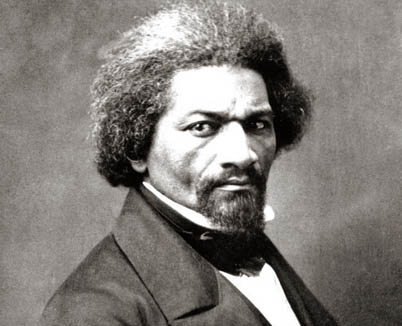
This book was written to have Douglass become a promoter of anti-slavery to aid the abolitionist and to make the "white" reader question their prejudice against slavery.
In interesting point that was made in the Preface of the story was that the mental deterioration of the African race is a result of slavery, not a preexisting quality of the slave population. Phillip explains that if this circumstance happened to any other race, it too would have the same effect.
Because the slave owner and other white people believe that the slaves lack intellect, I wanted to relate that to the songs sung by the slaves. Douglass attempts to make his white readers see the slaves as humans with both reason and emotion. He describes this through the way the slaves use their
songs.
Page 57 gave me intense feelings and made me feel a mix of sadness and happiness. There was one part where the slaves sang, "I am going away to the Great House Farm! O, yea! O, yea!" (Douglass 57). These people were so grateful for something so little, and they felt so privileged to be able to do this.
To me, the way the slaves sing the song to depict their emotions is extremely powerful and inspiring. Thought they may not always be cheerful (in fact, Douglass mentions that the songs are rarely happy), they seem to keep the slaves full of faith and uplift their spirits. That shows intellect. And that's not something that the slave owners taught them. It shows that they are humans, with real intellect and real emotions.

I completely agree with you that these songs showed a much higher intelligence than the slave owners believed that their slaves had! I enjoyed that Douglass wrote about the songs that were sung by the slaves, because it brought awareness to the fact that the slaves were humans with real emotions; to those who didn’t think that before. Songs do really have a way of reaching someones deepest emotions and really making them think about what is going on around them. And that is exactly what Douglass feels when he hears them, and he is shocked that many people, don't hear these as cry for help from slavery (57-58).
ReplyDeleteThe poem that really got to me, was when he was talking about this grandmother (92). While it is a poem, I listened to it on youtube as a song and it gave me chills! Reading it and then listening to it, gives me such a better grasp on the emotions behind everything going on. https://www.youtube.com/watch?v=MI2-zjHMGj0
I agree, this text was written very early considering the nature of its contents. Published in 1845, The Narrative of the Life of Fredrick Douglass, an American Slave predated the American Civil War by more than a decade. Yet Douglass, as a former slave with an impressively educated mind, was in a uniquely qualified position at this point in time to actually challenge the status quo. He was able to effectively communicate in a manner that would be well enough articulated and reasoned as to appeal to whites in an attempt to get them to realize how wrong the system of slavery in the United States truly was. By doing so, as the author of the above blog highlights, he also disproved the notion that slaves did not inherently posses the mental capacity for higher learning and greater education. His story, now well corroborated through innumerable details in the text makes it clear that he did actually begin his life at the bottom, as a slave, and end up and educated orator for the abolitionist movement.
ReplyDeleteDouglass certainty took a great risk in publishing this work, to such an extent that soon after its publishing, he fled overseas to avoid potential reinslavement. Yet so well received was the text that it offered him a far better platform than ever before to speak on behalf of the abolitionist movement in ways less conservative than before.